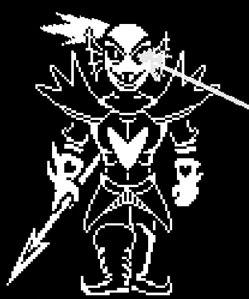
note the similarities in the shoulderpads, gloves, and chest
god of hyperdeath: draws on the power of every soul in the underground to become a god
undyne the undying: “I can feel everyone’s hearts beating as one!”
hearts and souls are essentially the same in undertale. there’s also a heartbeat sound in the background of “but the earth refused to die”
conclusion: undyne the undying tapped into the same power as the god of hyperdeath, the power of every soul in the underground, in order to come back from the dead and kick your murderous little ass. the difference is that where god of hyperdeath took it by force, in undyne’s case that power was given to her willingly for the sole purpose of stopping you.
To further this- the reason Asriel absorbs almost every monster in the underground (every monster besides Napstablook, in fact) is that the souls of every monster in the underground are enough to equal one human soul. So with the power of the six human souls and the monster souls, which equal one human soul, Asriel is able to carry infinite power.
Undyne doesn’t have six human souls, so- with the willing strength of every monster in the underground behind her- she has power roughly equivalent to one human soul. As we know from Alphys’s experiments, the key characteristic of a human soul is Determination. By channeling the power of everyone in the underground, Undyne the Undying is able to try and use Determination like a human would- except, as we also know from Alphys’s experiments, monster bodies can’t handle DT.
Undyne recieved the power of a human soul from the willing hearts of everyone in the underground, and was almost as powerful as a human. The only thing that stopped her was the limitation of her monster body.
4 Reasons why you probably shouldn’t see Chara or Frisk as Player
inserts.
I’m seeing it be debated, and I have toyed with the
idea myself, that Frisk, Chara, or even both are representations of “the Player”
either as “self-insertions” or as embodiments of two different mindsets of RPG
gamers: The “explorer” type and the “min-maxer” or “level grinder.”
But is it really fair for these characters story-arcs, to
have them boiled down to being allegories of common gaming tropes?
After all, we don’t normally accredit other fictional characters
achievements as our own. We did not save the world from and alien force, or
stop a falling meteor from bringing ruin to the land. Playing videogames, particularly
RPGs, allow us an experience where we can explore and interact with the
fictional world a game presents in ways that are unique to itself and its
genre. Yet, while we may name a character after ourselves we do not expect the character
to assume the role of us but rather us assuming the role of the character. (Hence,
the role playing aspect of a “role-playing-game.”)
Therefore here is a list of reasons why Chara and Frisk are not
“Player Inserts”
1. Any name you give the fallen human that is not Chara is
the incorrect name. Despite given the freedom to name the fallen human whatever
we want the game will always ask:
The game questions you about the name you just put in, not
many games do that. And while even Toby Fox says that the name you should use
is your own, there is only one name that the game will recognize as “True”
There is no “is this correct?” to make you second guess. For
there to be a true name all other names must be “false” or at the very least “borrowed”
ones.
Why would Toby Fox tell us to give the fallen human a name
that is not truly theirs? Well, why did Toby Fox hide Frisk’s name until the
very end, making us think that they were the fallen human we named from the beginning?
Perhaps it’s to add another layer of separation between us and the characters
we “play as” and assume we know all about.
2. Naming the fallen human after us does not turn them into
us. They have their own specific backstory that we can not “customize.” Just as
every other person who has your name in real life is not an extension of yourself;
the fallen human does not become a doppelganger of the player. ((Or an
alternate universe version of yourself)) Just as naming a character in a
videogame, even blank slate characters in RPGs, does not make them “us”. We
just make the game more convenient for us to get into the character’s shoes when
we name them after ourselves.
((Chara has a borderline Shakespearian tragedy as a backstory that we have no direct part in.))
3. Frisk’s obscure backstory does not make it open for self
insertion. Just like how their name was known only to them and not to us, their
history is something only they know.
((I know I certainly don’t))
4. What we consider “a game” that we play to us, is the
world to them.
The narration is done for Frisk’s sake not our own. If save
files exist for the character’s own benefit in universe is it really such a
stretch that the other “RPG mechanics” are also a part of its nature? Barring
the “Chara as the narrator theory” at the very least Sans speech about LOVE and
Chara’s speech at the end of the Bad route breaks down things we players know
as STATS to have in world significance.
Should we really impose our “gamer logic” on a game that is actively
using that logic against us?
In the end what claim do we really have on these mysterious fictional kids outside of getting Frisk from point A to point B? Not much, but that’s what a role playing game is: a journey we walk in another’s shoes, not our own. Games give us the power to determine the outcome of their tale, be it good or bad.
I think the shattering is a visual indication of death. But like we see in the True End fight a human soul can mend itself. But not all humans have the level of determination Frisk has. So when a normal human (or a human who willingly refuses to use their save file) gets killed by a monster it probably looks like this:
But whenever we get a game over in Undertale it’s more like:
((and in the final battle Frisk’s Soul is so determined that it just outright refuses to die! Hardcore kid right here))


 honestly just really like undertale