I’ve seen that quote passed off as the smoking gun that Chara was evil all along but I think there’s a lot more to that statement than what’s on the surface, and I don’t think that’s just because Asriel may have been hedging his words to be polite.
I think Asriel was being very literal when he said “the greatest person,” meaning that Asriel literally thought Chara was the greatest person ever. When you hear Asgore’s talk of Chara being “the future of humans and monsters”, history books saying monsters no longer feared humans when they moved to New Home, and Flowey suggesting that Asgore would show the souls to Chara but not him, it’s clear that Chara was a pretty big deal in the Underground.
Asriel trusted Chara implicitly, even in spite of his own conscience and common sense. As we can plainly see, this attitude is not healthy. Obviously it wasn’t healthy for Asriel, and I think most of the people familiar with this blog will agree that it wasn’t healthy for Chara either.
In the past I’ve heard rants and analyses about the “chosen one” trope in fiction and how it would be terrible to be in the shoes of someone like Harry Potter (even without the death and tragedy in his past) because everyone would have these lofty, unproven expectations of you. This would be a bad enough fate for a regular kid, but imagine how it must have eaten away at somebody like Chara.
This is one reason why I find it hard to swallow theories that call Chara a psychopath or narcissist, because a person like that would thrive in a situation where people assume they’re great and automatically trust their judgment. I can’t imagine a person like that leaving, committing suicide, or deliberately surrendering control over half of their own soul (on the near-0-percent chance that Chara knew about the split control beforehand).
When Asriel says Chara wasn’t the greatest person, one of my main takeaways is that he’s rejecting these expectations that he’s clung to for so long. Heck, he still believed Chara could solve all of his problems even when he was Flowey, and it was that desperate attachment that led to his fascination with Frisk and his desire to kill them over and over just to keep them around.
Having said that, I don’t think Asriel’s statement was completely innocuous or devoid of any lingering resentment. Chara’s situation was tragic but they still dragged Asriel into their own crusade against humanity and it cost him his life. Asriel has every right to feel betrayed and disillusioned after having his most intimate trust exploited like that.
This interpretation isn’t mutually exclusive with the idea that Chara was a tragic and misunderstood character, mind you. After all, most UT fans understand Toriel’s resentment toward Asgore while also sympathizing with Asgore’s situation. If we’re going to compare the two pairs of Dreemurrs, I’d say there’s more evidence to suggest that Asriel and Chara reconciled than there is for Toriel and Asgore.
For one thing, Asriel keeps watch over Chara’s grave in the true pacifist ending. If Asriel’s quote was meant to be an epiphany that Chara was some kind of abusive monster then I doubt he’d want to be in a place that would remind him of them. If we interpret Flowey’s true reset dialogue to be addressed to Chara then it’s clear that Flowey is at least on speaking terms with Chara and feels he can reason with them (whereas if Asriel realized Chara’s “true” evil nature then you’d think he’d try to stop them or go get help).
As much as I like to imagine these two siblings getting along and being the best of friends, I doubt that their reunion after the True Pacifist ending would’ve been all hugs and kisses. Asriel’s probably quick to forgive but I’m sure he would’ve had a lot to get off his chest. It’s likely that Chara already heard what Asriel said to Frisk and I’m sure they’d encourage him to be honest with his feelings instead of trying to be meek or polite. I don’t picture their conversation being the happiest one, but it would be therapeutic for both of them and help them get closure.
(submitted by vgfm) (*standing ovation for this post, holy cow*)
Honestly this is so well written I have nothing else to add besides mentioning how Monster Kid also goes through a similar thing of realizing that the “best person ever!!!” in their life has flaws and moves on to a new person who is “Way cooler.”
Neither of these “realizations” mean that Undyne and Chara are horrible people in the eyes of their biggest fans, but that the unmet expectations in their character damaged these two’s perception of them.
So every now and then I see posts from various Undertale fans expressing horror over the events of a No Mercy Run and wishing that they could fight Chara/The Fallen Child and kill them.
And these posts always leave me pretty >: because like… I’m a big advocate of the point of the No Mercy run being that the tragic events are the fault of the person playing the game, and also the characterization of Chara/TFC being more complex than “they were an irredeemable demon all along,”
but even putting aside those thoughts, I can’t help but wonder how in the hell anyone, after watching or playing through a route that demonstrates, over and over and over and over again, that killing others is NOT the correct thing to do
can walk away from it going “Golly, I wish this storyline ended with me killing Chara! That would surely fix everything!”
You’ve fallen in a hole on the cursed mountain, a talking flower nearly tried to kill you, the mountain is full of monsters, and there is this voice reading stuff and describing things for you while you explore.
They seem helpful? A bit snippy at times, but helpful.
For the sake of your mental health, It’s best just to accept things as they come and move on.
What is this? How is this? We know “who” is this but…exactly how are we seeing this? Where did this come from?
Certainly they did not walk from all the way back here:
where their body was buried, which by now is probably in an advanced state of decay. (also not a zombie)
But is this being something that can be classified as a ghost, when we have seen previous examples of ghosts being a type of monster in the world of Undertale?
Or are human ghosts by nature different then monster ghosts? But this spirit can later identify themselves as a “demon” if the geno-run is done twice. So I submit to you that this is not a normal phantom or demon.
This is Chara’s doppelganger, their eidolon. A greek concept that is
a spirit-image of a living or dead person; a shade or phantom look-alike of the human form.
This fits their physical appearance and would mark them different then the other ghosts of Undertale. But an eidolon isn’t just defined as a kind of ghost, but an image of an ideal, an “idol.” they are a manifestation of the ideal that was created by “your guidance”
There are not just Chara, they are not even just the narration anymore, they are the ideal image of Chara created by the actions of the Player through Frisk.
And in the second to last verses of Walt Whitman’s poem Eidolons (about eidolons) reads this:
And thee my soul, Joys, ceaseless exercises, exaltations, Thy yearning amply fed at last, prepared to meet, Thy mates, eidolons
Thy body permanent, The body lurking there within thy body, The only purport of the form thou art, the real I myself, An image, an eidolon.
The Soul meeting their mate/friend/“partner” the eidolon. Frisk the Soul meeting Chara the eidolon that was created by Frisk’s actions.
The permanent body, lurking within the body. The effects of creating this eidolon are permanent and are not canceled out by True Resets. This manifestation will carry over from the geno timeline and lurk within Frisk’s body until the end of the Souless Pacifist run.
Before reaching the end you can abort the run and Chara’s spirit will revert to being the benign narrator, but once you create this ideal version of them out of LOVE, it’s not going to go away. (unless you fully wipe your data) This branch entity is no longer a spirit bound to Frisk, it’s not the narrator in the next run, it’s a lingering reminder of your past choices.
(so not only are you dooming Frisk, and everyone else, but you are dooming the passive narrator Chara from finding peace in the Restarted timeline as well when you do a Soulless pacifist run)
4 Reasons why you probably shouldn’t see Chara or Frisk as Player
inserts.
I’m seeing it be debated, and I have toyed with the
idea myself, that Frisk, Chara, or even both are representations of “the Player”
either as “self-insertions” or as embodiments of two different mindsets of RPG
gamers: The “explorer” type and the “min-maxer” or “level grinder.”
But is it really fair for these characters story-arcs, to
have them boiled down to being allegories of common gaming tropes?
After all, we don’t normally accredit other fictional characters
achievements as our own. We did not save the world from and alien force, or
stop a falling meteor from bringing ruin to the land. Playing videogames, particularly
RPGs, allow us an experience where we can explore and interact with the
fictional world a game presents in ways that are unique to itself and its
genre. Yet, while we may name a character after ourselves we do not expect the character
to assume the role of us but rather us assuming the role of the character. (Hence,
the role playing aspect of a “role-playing-game.”)
Therefore here is a list of reasons why Chara and Frisk are not
“Player Inserts”
1. Any name you give the fallen human that is not Chara is
the incorrect name. Despite given the freedom to name the fallen human whatever
we want the game will always ask:
The game questions you about the name you just put in, not
many games do that. And while even Toby Fox says that the name you should use
is your own, there is only one name that the game will recognize as “True”
There is no “is this correct?” to make you second guess. For
there to be a true name all other names must be “false” or at the very least “borrowed”
ones.
Why would Toby Fox tell us to give the fallen human a name
that is not truly theirs? Well, why did Toby Fox hide Frisk’s name until the
very end, making us think that they were the fallen human we named from the beginning?
Perhaps it’s to add another layer of separation between us and the characters
we “play as” and assume we know all about.
2. Naming the fallen human after us does not turn them into
us. They have their own specific backstory that we can not “customize.” Just as
every other person who has your name in real life is not an extension of yourself;
the fallen human does not become a doppelganger of the player. ((Or an
alternate universe version of yourself)) Just as naming a character in a
videogame, even blank slate characters in RPGs, does not make them “us”. We
just make the game more convenient for us to get into the character’s shoes when
we name them after ourselves.
((Chara has a borderline Shakespearian tragedy as a backstory that we have no direct part in.))
3. Frisk’s obscure backstory does not make it open for self
insertion. Just like how their name was known only to them and not to us, their
history is something only they know.
((I know I certainly don’t))
4. What we consider “a game” that we play to us, is the
world to them.
The narration is done for Frisk’s sake not our own. If save
files exist for the character’s own benefit in universe is it really such a
stretch that the other “RPG mechanics” are also a part of its nature? Barring
the “Chara as the narrator theory” at the very least Sans speech about LOVE and
Chara’s speech at the end of the Bad route breaks down things we players know
as STATS to have in world significance.
Should we really impose our “gamer logic” on a game that is actively
using that logic against us?
In the end what claim do we really have on these mysterious fictional kids outside of getting Frisk from point A to point B? Not much, but that’s what a role playing game is: a journey we walk in another’s shoes, not our own. Games give us the power to determine the outcome of their tale, be it good or bad.
Undertale timeline theory: The year Chara came to the Underground,
is the same year the royal family moved the capital from “Home” to “New Home.”
Here is my reasoning:
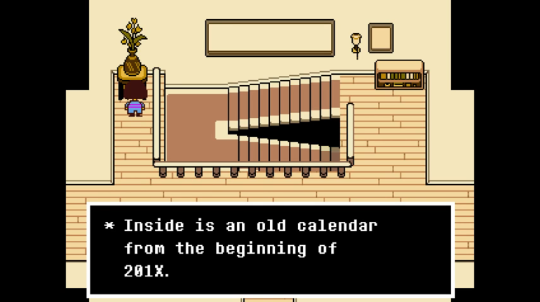
At Toriel’s house in the Ruins we find a calendar from
beginning of the year 201X and we find a calendar from the end of the year 201X
(with the day of Chara’s arrival circled on it) at Asgore’s home.
When Toriel left her husband a year probably already passed (at
least) before Chara and Asriel’s death and I doubt she would have taken
something like an old calendar with her during her sudden disappearance. (She
was also allegedly transporting Chara’s body to the Ruins to be buried so it’s
most likely she couldn’t take much else with her)
My guess is that during the move from Home to New Home the royal family left
most of the houses furnishings behind in case they ever needed to come back to
the old capital for business or vacationing.
Also, building a new Capital
City would take time, “Rome was not built in a
day,” after all. But one of the first buildings to go up would have been the
Royal Family’s living quarters, and considering how humbly they live compared
to other examples of royalty, it would have taken roughly around a year to complete.
There are also the living arraignments of Home and New Home
to consider. The kid’s room in Home has one bed and the table setting in the
living room has two adult chairs and one kid’s sized chair. Whereas in New home
we see two beds in the children’s room and a total of four chairs.
This would mean that Asriel had lived in Home for a while, which is much closer
to the Ruins where Chara fell in, making their chance meeting more probable
than if Asriel had been living at New Home during the year 201X.
Another plausible support for this is how the monster
history book stated that the monsters went further into the mountain because “They
feared the humans no longer.”
Could Chara’s coming to the underground and
becoming a part of the royal family contributed to this change in sentiment?






 honestly just really like undertale